
If you've ever had a finance team member manually re-enter invoice data from your billing tool into SAP/Oracle/NetSuite, this article is for you. We feel your pain.
There's a special kind of corporate suffering that happens at the intersection of billing systems and ERPs. It's quiet. It's persistent. And it costs enterprises millions in labor hours, reconciliation errors, and delayed financial closes. Let's talk about why this keeps happening and what to do about it.
The Great Disconnect
Your billing system creates invoices. Great. Your ERP (SAP, Oracle, NetSuite, Sage, pick your poison) expects those invoices in a very specific format, with very specific account mappings, following very specific revenue recognition rules. And nothing matches.
The billing system thinks in terms of subscriptions, usage tiers, and customer accounts. The ERP thinks in terms of journal entries, GL accounts, and cost centers. Translating between these two worldviews is where entire integration teams go to spend their careers.
Common symptoms of the disconnect:
- Invoice amounts in billing don't match the ERP because of rounding differences
- Tax calculated by the billing system uses different rules than the ERP tax engine
- Customer records are duplicated (or worse, slightly different) across both systems
- Revenue recognition timing is different because the billing system recognizes on invoice date while the ERP uses delivery date
- Credit notes issued in billing never make it to the ERP, creating phantom receivables
The CSV Export Ritual
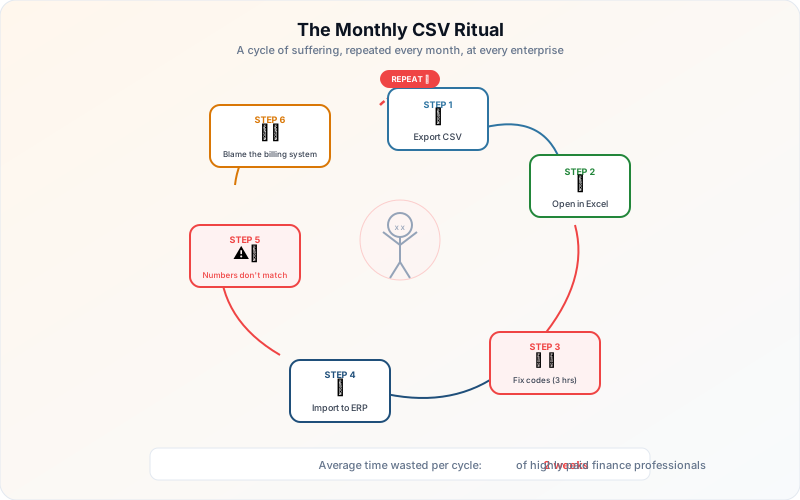
Every company with this problem develops The Ritual. It goes something like this: on the second business day of each month, someone in finance exports a CSV from the billing system. They open it in Excel. They spend two to four hours reformatting it, fixing account codes, adjusting for the invoices that were voided after export, and adding the manual adjustments that “the billing system doesn't handle.” Then they import it into the ERP. Then they spend another day reconciling why the numbers still don't match.
This ritual is so common it has earned its own terminology in the industry: “monthly close reconciliation.” At large enterprises, this process can take two weeks. Two weeks of highly paid finance professionals doing what is essentially a very expensive copy-paste operation. Every. Single. Month.
Why Real-Time Sync Matters
The batch-export approach breaks down as you scale. More invoices mean more reconciliation work. More products mean more account mapping complexity. More entities mean more inter-company eliminations. The problem grows quadratically, not linearly.
Real-time synchronization between billing and ERP changes the game:
- Invoices flow to the ERP as they are finalized, not in monthly batches
- Credit notes and adjustments are reflected immediately, keeping AR balances accurate
- Revenue schedules are created in the ERP at the same moment the billing event occurs
- Cash application from payment processors updates both systems simultaneously
- Month-end close becomes a verification exercise, not a reconciliation marathon
The Event-Driven Approach
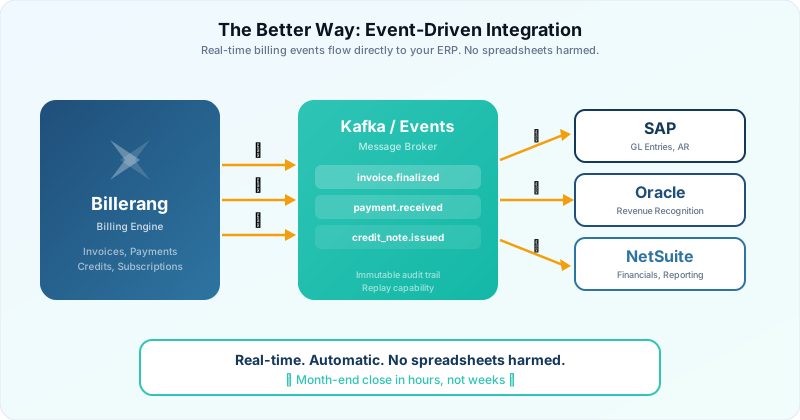
The modern solution is event-driven integration. Instead of batch exports, your billing system publishes events like invoice.finalized, payment.received, and credit_note.issued to a message broker like Kafka or via webhooks. An integration layer consumes these events, transforms them into ERP-compatible formats, and pushes them into the right accounts.
This approach gives you:
- An immutable audit trail of every financial event
- The ability to replay events if something goes wrong (instead of re-exporting CSVs)
- Decoupled systems that can evolve independently
- Near-real-time financial visibility for your CFO (they will love you)
- A month-end close measured in hours, not weeks
Your Billing Platform Should Be Your ERP's Best Friend
A well-architected billing platform doesn't fight your ERP. It speaks its language. It understands that the ERP is the system of record for financials and acts as a reliable, structured source of billing events that the ERP can consume without human intervention.
The integration should be boring. Invisible. Something your finance team forgets exists because it just works. That's the goal. Not another CSV export. Not another reconciliation spreadsheet. Just clean data flowing from billing to ERP, automatically, in real time, every single day.
Billerang was designed from day one with ERP integration as a first-class concern.
See our integration capabilities →