
You launched a brilliant SaaS product. Customers love it. Then someone in the C-suite says: “What if we charge per API call?” And suddenly your best engineers are writing billing logic instead of features.
This is a story as old as SaaS itself. It starts innocently enough. A product-market fit celebration, a board meeting about monetization, and a whiteboard session that ends with the words per-unit pricing. What follows is a slow, predictable descent into billing infrastructure hell.
The Hidden Cost of Building Billing In-House
Let's be honest about what “we'll just build it ourselves” actually means. Sprint one: a Stripe integration and a cron job. Feels great. Ship it. Sprint two: someone discovers you're not handling proration when customers upgrade mid-cycle. Sprint three: tax calculations. Sprint four through infinity: edge cases that multiply like rabbits.
Here's an incomplete list of what you'll eventually need to build:
- Proration logic (upgrade, downgrade, mid-cycle changes)
- Dunning workflows (retry logic, grace periods, customer notifications)
- Tax calculation and compliance (VAT, sales tax, nexus rules)
- Invoice generation with proper formatting and legal requirements
- Revenue recognition that satisfies ASC 606 / IFRS 15
- Usage metering, aggregation, and rating
- Credit notes, refunds, and adjustments
- Multi-currency support with exchange rate handling
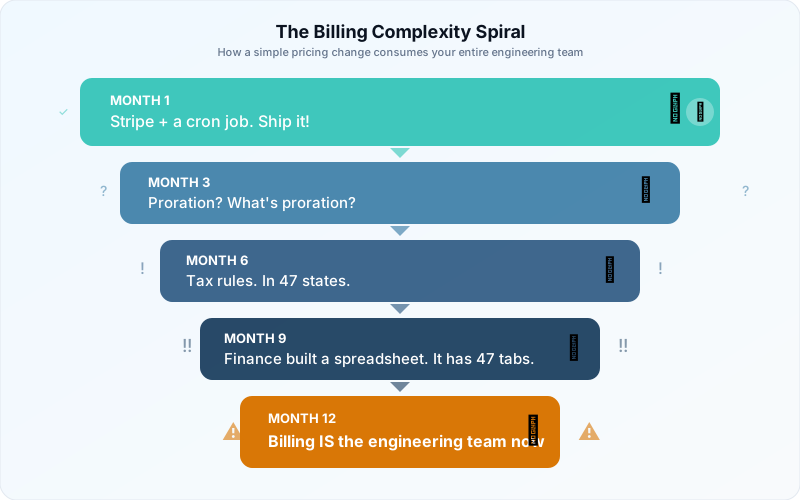
Each one of these is a project. Not a ticket. A project. With its own edge cases, its own test suite, and its own maintenance burden. And they interact with each other in ways that will make your senior engineers question their career choices.
The Spreadsheet Phase
You'll know you've reached this phase when your finance team starts maintaining a parallel billing system in Google Sheets. It usually starts with “I just need to double-check a few invoices.” Within three months, there's a 47-tab spreadsheet named BILLING_MASTER_v3_FINAL_FINAL_USE_THIS_ONE.xlsx that is the actual source of truth for your revenue numbers.
The spreadsheet phase is a symptom, not a disease. It means your billing system can't answer basic questions like “how much MRR did we add last month?” or “which customers are on a plan we deprecated six months ago?” So your finance team builds their own answers. With VLOOKUP. And prayer.
A Solved Problem You Keep Re-Solving
Here is the uncomfortable truth: billing is a well-understood domain. Subscription billing, usage-based rating, invoicing, dunning, revenue recognition. These are solved problems with known patterns. The CDR (Call Detail Record) processing that telecoms perfected in the 1990s is architecturally identical to what your API metering system needs to do. The mediation and rating engines that power every mobile carrier on earth are doing exactly what you're trying to build with a calculateInvoice() function and a Redis queue.
But every engineering team thinks their billing needs are unique. They're not. Your tiered pricing with volume discounts and a free tier? That's a rating table. Your “customers get credits they can apply to future invoices” feature? That's a wallet with prepaid balance management. Your “enterprise customers need custom contracts” requirement? That's offer catalog configuration. All solved. Decades ago.
The Plot Twist: Your Billing System Becomes the Bottleneck
And here's where it really hurts. After months of engineering investment, your homegrown billing system becomes the thing that prevents you from launching new pricing models. Want to add a usage-based component to your flat-rate plan? That's a quarter of engineering work. Want to offer annual billing with a discount? Your proration logic wasn't designed for that. Want to enter a new market with different tax rules? Good luck.
The billing system that was supposed to unlock revenue growth is now the reason you can't experiment with pricing. Your product team has ideas. Your sales team has customer requests. And your engineering team says “we can do that, it'll take about six months.” For a pricing change. Six months.
Your Engineers Should Ship Products, Not Invoices
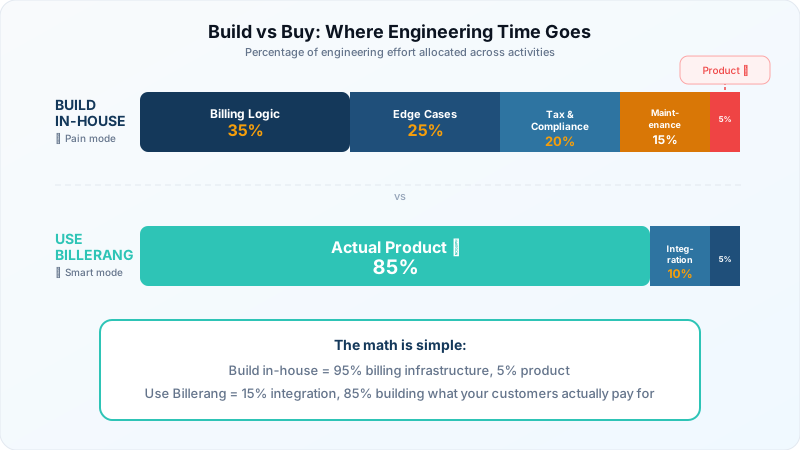
The real cost isn't the engineering hours spent building billing infrastructure. It's the features that didn't get built. The product improvements that stayed on the backlog. The competitive advantages that evaporated while your team was debugging why customer #4,271 got charged twice for a prorated upgrade.
Billing is infrastructure. Critical, complex, and absolutely essential. But it's not your product. It's not your competitive advantage. And it's not where your best engineers should be spending their time. Let them build the thing your customers actually pay for.
Curious how a purpose-built billing platform handles all this out of the box?
See what Billerang does for your engineering team →